Break down the script
Define characters, locations, pacing, and shot count per episode.
Start with the job, then choose the product
This page explains how to move from script to delivery and when to choose an all-in-one studio, a bring-your-own-API workflow, or an API-first production stack, with model evidence and platform boundaries kept comparable.
For a first production, validate script, storyboard, character assets, generation, and editing in an integrated studio. Move to your own APIs or an API-first stack when you need broader model choice or batch automation.
Production workflow
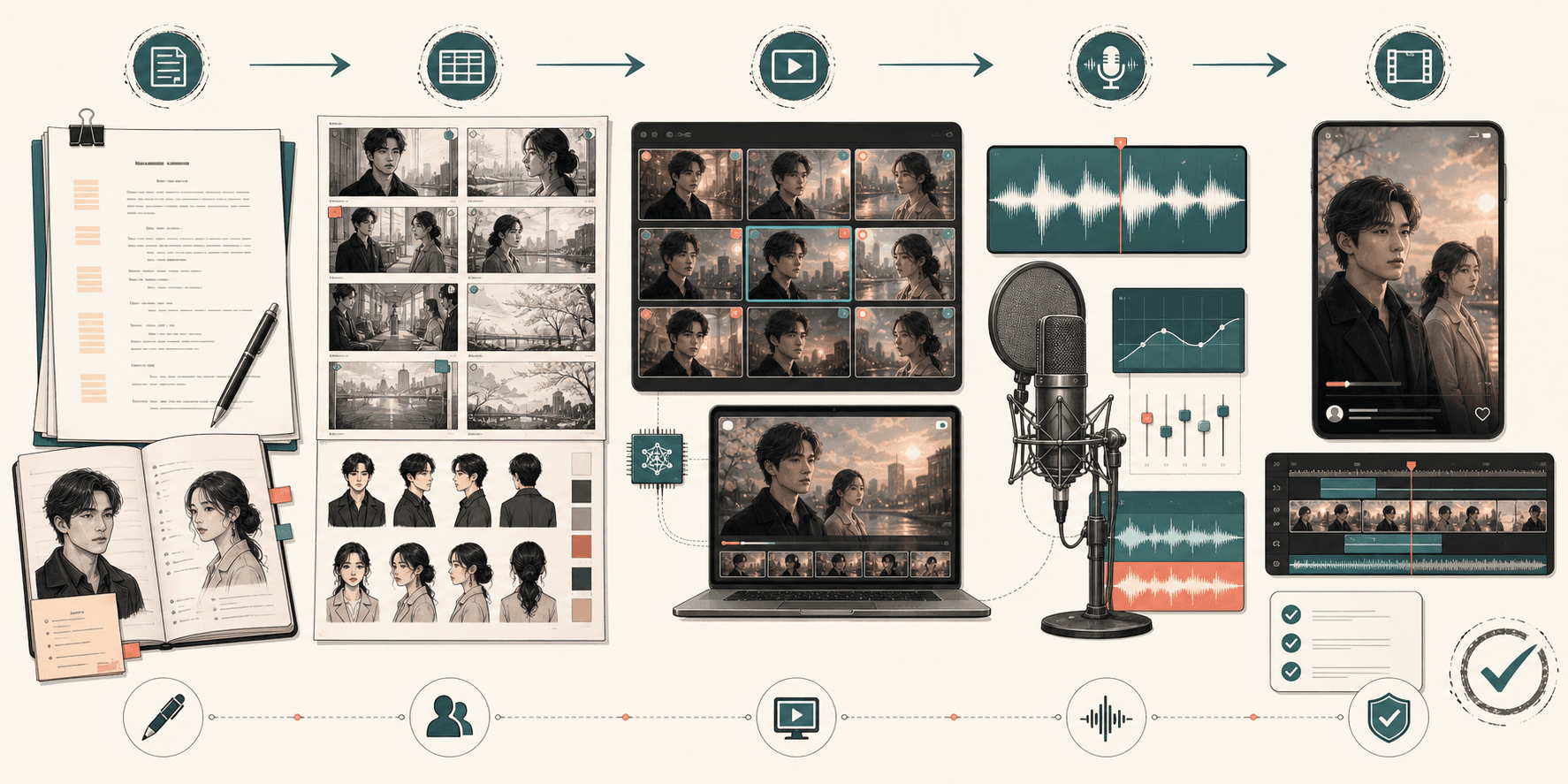
Define characters, locations, pacing, and shot count per episode.
Create reusable character sheets, references, and shot prompts.
Allocate Seedance, Kling, or Veo by shot importance and reserve retries.
Produce and review dialogue, narration, sound effects, and lip sync as separate tasks.
Check character drift, continuity, subtitles, and commercial rights.
Three practical routes
Best for: First projects, solo creators, and fast delivery
Less setup, but model choice, point allowances, and export rules depend on the platform
Review Updream →Best for: Creators who already have API keys and want a visual workflow
More model freedom, but you must manage platform settings, API keys, and call records together
Compare video APIs →Best for: Batch production, engineering teams, and automation
More model and automation control, but you own storyboard, queue, retry, and asset-management logic
Open API pricing →Platform directory
This is not a single-platform ad slot. Every platform uses the same comparison fields, and future additions enter the same structure with better-verified platforms first.
| Capability | Updream | Pixmax | DramaBuddy |
|---|---|---|---|
| Script / storyboard | ● Reviewed | ● Reviewed | ● Reviewed |
| Character assets | ● Reviewed | ● Reviewed | ● Reviewed |
| Video generation | ● Reviewed | ● Reviewed | ● Reviewed |
| Voice / audio | ○ Partial | ● Reviewed | ● Reviewed |
| Editing / repair | ● Reviewed | ● Reviewed | ○ Unverified |
| Team collaboration | ○ Partial | ● Reviewed | ● Reviewed |
| Bring your own API | ○ Community evidence | ○ Unverified | ○ Unverified |
Only verifiable information from official public pages or reviewed product UI is recorded. Fields without public evidence are marked unverified rather than inferred from marketing claims. Checked 2026-07-18.
Short-drama workflow pilots for individuals and small teams
Public pricing: Free entry; Pro ¥949/year (about ¥79/month)
Open independent review →Creators who want a fast script, storyboard, generation, and repair loop with a possible bring-your-own-API route.
Procurement teams that require public enterprise SLAs, developer API docs, or verified refund and invoice policies.
Public refund terms, invoice support, operating history, team pricing, and public developer API docs.
A multi-model production platform for assets and team collaboration
Public pricing: From ¥69 for 1,190 points; the official page states ¥1=15 points and purchased points do not expire
Visit official site ↗Studios that need unified text, image, video, and audio model routing plus reusable character, scene, storyboard, and project assets.
Developers who only need one fixed video-model API and do not need canvases or project management.
Bring-your-own API keys, refund conditions, invoice coverage, and public developer API docs.
A comic-drama production platform focused on web-novel and IP adaptation
Public pricing: No verifiable price found on the public product page
Visit official site ↗Content teams starting from novels or scripts that need character design, storyboard breakdown, multimodal assets, and shot-level review.
Users focused only on the lowest one-off generation price or public model-level API rates.
Public plan pricing, refund policy, invoice support, bring-your-own API keys, and public developer API docs.
Dedicated budget tool
To keep workflow selection separate from budget assumptions, this page only links to the dedicated tool. Enter episode count, runtime, candidate-shot multiplier, and video model there.
Open the AI short-drama cost calculator →Independent evidence + internal routes
| Model | External rank | Elo | Benchmark price | Details |
|---|---|---|---|---|
| Seedance 2.0 | #3 | 1222 | $9.07/min | Prices and providers → |
| Kling 3.0 | #8 | 1107 | $20.16/min | Prices and providers → |
| Veo 3.1 | #11 | 1089 | $24/min | Prices and providers → |
Rank and Elo use the registered Artificial Analysis video snapshot. Benchmark price is not the same as the current lowest ComputeUnion provider quote; open the detail page to check source and freshness.
Before you pay
Yes, but the workflow should be separated into script, storyboard, character assets, shot generation, voice, and editing. Solo creators often start with a workflow platform and move quality-critical or high-volume shots to external APIs.
Candidate-shot generation, character consistency, and revisions are common bottlenecks. Lock reusable character assets and shot rules, then validate the workflow with a small batch.
Choose an all-in-one platform for workflow speed, asset management, and a lower learning curve. Choose bring-your-own API or an API-first stack for model freedom, automation, and call-level control.
Lock the character sheet, clothing, visual language, and reference images before generation. Reuse those constraints across shots and reserve revision passes.
Check the platform terms, model terms, and rights to every uploaded asset. The ability to generate content does not automatically grant unrestricted commercial rights.