RTX 5090 Prices Are High. Should You Buy or Rent a GPU?
·5 min read
Buying an RTX 5090 now means committing tens of thousands of yuan before the first AI job runs. If your queue is intermittent, price the rental first. A short rental can finish the batch in front of you without committing to a workstation purchase.
That does not make every “almost ¥60,000” listing representative, or every rental cheaper. We checked a card listing, Compshare’s official price table and seven days of our own public rental observations.
A card purchase versus an hourly instance
On October 20, a JD listing for an RTX 5090 32GB Founders Edition displayed ¥47,999, with a notice to sign in for the checkout price. This is one advertised offer, not a market average or evidence that ordinary completed sales have reached ¥60,000. Check the specific version, warranty and invoice terms; a 5090D v2, laptop and complete workstation are not interchangeable purchases.
For GPU workloads, the other side is more immediately useful. Compshare’s official table lists one RTX 5090 32GB, 14 CPU cores and 48GB host RAM at ¥3.36/hour or ¥2,021.40/month. The 48GB is system memory, not GPU VRAM. These are prices for the specified single-GPU instance.
Public prices checked October 20, 2026. The card listing is not a guaranteed transaction price. Rental storage, image fees, stock, eligibility and service terms must be checked in the actual order.
Have rental prices risen with card prices?
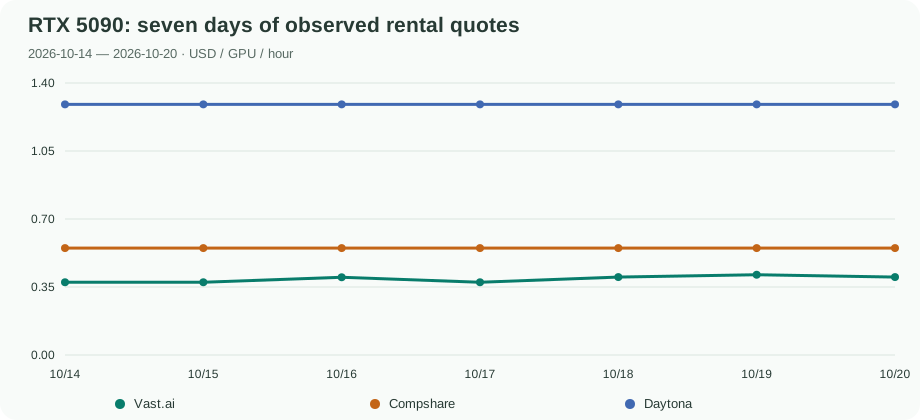
Our seven-day observations do not show an across-the-board surge. Vast.ai fluctuated and ended about 7.13% above its first observation; Compshare and Daytona were essentially flat. A costly card purchase does not automatically imply an equivalent increase in the price of one GPU hour.
| Provider | 10/14 → 10/20 | What the observations show |
|---|---|---|
| Vast.ai | $0.3744 → $0.4011 | About +7.13% between endpoints, with fluctuations |
| Compshare | $0.5503 → $0.5503 | Essentially flat at four decimal places |
| Daytona | $1.2900 → $1.2900 | Flat across the recorded period |
All values are USD per GPU hour. These are each provider’s daily latest available observations, not GPU purchase prices or seven-day price locks on identical machines. Inventory and configuration changes can affect the series. The October 20 Vast.ai observation is a two-GPU node: $0.4011 per GPU means approximately $0.8022 per node hour. The current Compshare record is a 16-core/96GB host, unlike the 14-core/48GB offer below; full configurations are not attached to every historical point.
Daily data and methodology
The period is October 14–20, 2026. The source page merges public snapshots and daily latest records. All three observed providers are retained; there are no missing dates or simulated points. An observation does not establish an all-day price or future stock.
Download 21 public observations as CSV · Source, capture time and methodology JSON
The chart describes one recorded week, not next month. The RTX 5090 rental page carries subsequent observations. Pay particular attention to whole-node requirements: a low per-GPU price does not mean that one card can be rented separately.
One hundred hours a month is not an always-on service
Using the listed ¥3.36/hour instance, with no assumed coupons or resale forecasts:
| Billed hours per month | Hourly rental total | Illustrative schedule |
|---|---|---|
| 100 hours | ¥336.00 | A few batches each week |
| 300 hours | ¥1,008.00 | About 10 hours daily, over 30 days |
| 600 hours | ¥2,016.00 | About 20 hours daily, over 30 days |
At 100 billed hours per month, base instance rental is ¥336, or ¥4,032 across twelve identical months. For experiments or occasional image and video batches, that is a modest commitment compared with buying the card. Include environment setup and downloads in billed time, not just inference runtime.
For a persistent queue, compare the monthly plan. The same listed configuration is ¥2,021.40/month, equivalent to approximately 602 hourly-billed hours at ¥3.36. At 200–300 hours, hourly base rental remains lower. A need to retain resources may change the decision, but check the monthly plan’s region, renewal and reservation rules rather than assuming that a lower advertised hourly equivalent is enough reason to subscribe.
Calculations use the October 20, 2026 official list prices and exclude extras. ¥4,032 = 100 hours × 12 months × ¥3.36. Approximately 602 hours is a list-price crossover, not an inventory or performance guarantee. Actual offers and billing terms govern.
Who should rent first, and who should still consider buying?
I would rent while requirements are changing. Today’s image workflow may become tomorrow’s video queue, followed by a model that does not fit in 32GB. Rental lets you change the machine. It also lets you test a 4090 first: if it completes your workload at a lower total job cost, there is no obligation to use the newer model.
Buying deserves a serious quote when work is steady every day, data must remain on premises, or your team already operates suitable facilities. Compare a complete server with a matched rental configuration, rather than treating the price of one card as the total cost of a working server.
If monthly usage is still unknown, a short rental and a real bill are a better first step than a large purchase. Once demand becomes steady, decide whether to turn that rental budget into a hardware purchase. A price spike alone is a poor reason to commit.
After registration, select RTX 5090 and check card count, host RAM and region. Start with hourly billing, record the cost and runtime of your batch, then check which resources continue billing after shutdown. ComputeUnion’s GPU rental comparison can help you explore alternatives without committing to a purchase first.